Written by Akela Craig, May 26, 2026
What does it mean to experience nature in an age when experience itself is increasingly mediated by technology? In contemporary visual culture, our attention is increasingly channeled by screens, digital media, and algorithmically-generated imagery. As society negotiates the recent consequences of AI fatigue, the aftermath of the pandemic, the advent of social media, and decades of media saturation, direct encounters with the natural world have diminished in what writer and lepidopterist Robert M. Pyle describes as an “extinction of experience.”
In “Extinction of experience: the loss of human–nature interactions,” Masashi Soga and Kevin J. Gaston argue that–driven by technological advancements and the emergence of sedentary pastimes, among other triggers–outdoor experiences with nature are increasingly being displaced by “virtual alternatives.” They further suggest that this decline in direct interaction with nature not only reduces emotional affinity toward the natural world but also has weakened pro-environmental attitudes and behaviors, producing what they describe as a “cycle of disaffection toward nature.” This loss of direct contact does not eliminate interest in nature; instead, it has prompted a renewed and evolving artistic engagement with the natural world.
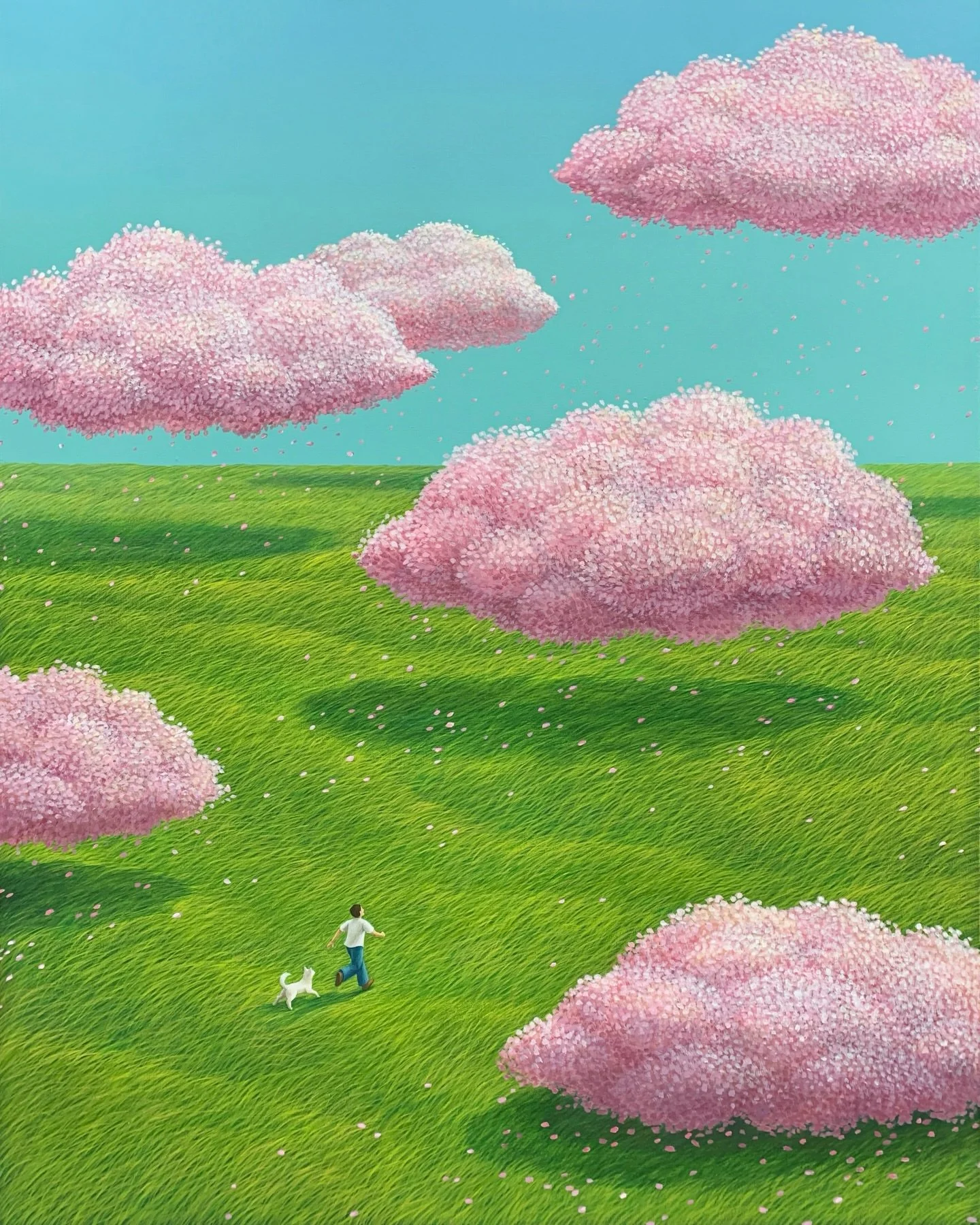
Mulgil Kim, Spring Clouds, 2026
As live experience declines, nature is increasingly encountered through mediated forms–screens, images, and immersive constructed environments. In this context, the natural world has re-emerged as a critical site for artistic engagement, but often in forms shaped by these conditions, where visual intensity and simulated experience begin to stand in for direct access. This shift invites comparison to 19th-century Romanticism, which emerged under similarly transformative conditions.
Romanticism reflected a collective artistic desire to return to the sublime in nature, to intense emotion, and to individualism. 21st-century artists respond to a technological revolution and generations of Industrial progress. This response might be termed Neo-Romanticism, a movement characterized by hyperreal, surreal, and augmented depictions of the natural world.
Compounding generations of urbanization, technological progress, consumerism, and online culture has left us grasping for truth and connection amidst a matrix of simulated reality. Philosopher Jean Baudrillard warned of this in his 1981 book Simulacra and Simulation, which inspired the 2000s film franchise, The Matrix.
Artists across mediums offer an exit route, but which is the red pill and which is the blue? Digital artists such as Refik Anadol produce large-scale, data-driven installations that circulate within museums and digital platforms as immersive experiences. These works are often shaped by spectacle, immersion, and technological novelty, and align with a cultural desire for visually captivating, screen-based encounters with nature. Meanwhile, there is a marked growth in interest in paintings re-engaging with nature.
A range of artists (explored below) engaging with the natural world can be traced by varying degrees of mediation–from sober depictions of landscapes to highly surrealized, augmented visions. Rather than a stylistic category, this spectrum should be understood as a shift in the degree to which nature is observed, altered, or reconstructed. Each artist engages with nature employing varying levels of sobriety, distortion, and surrealism. Is this a testament to the artist’s triumph over realism, or indicative of a need to compete with our simulated reality?
Alas, it seems the contemporary painter’s reengagement with nature is not free from the conditions of the Matrix. Can the artist settle for depicting nature realistically to win our re-engagement, or must it be fantastical to be effective, diverting our interest from our highly curated and aestheticized reality?
“We will live in this world, which for us has all the disquieting strangeness of the desert and of the simulacrum, with all the veracity of living phantoms, of wandering and simulating animals that capital, that the death of capital has made of us-because the desert of cities is equal to the desert of sand-the jungle of signs is equal to that of the forests-the vertigo of simulacra is equal to that of nature-only the vertiginous seduction of a dying system remains, in which work buries work, in which value buries value-leaving a virgin, sacred space without pathways, continuous as Bataille wished it, where only the wind lifts the sand, where only the wind watches over the sand.” (Jean Baudrillard, Simulacra and Simulation, pg.153)
What does it mean to experience nature in an age when experience itself is increasingly mediated by technology?
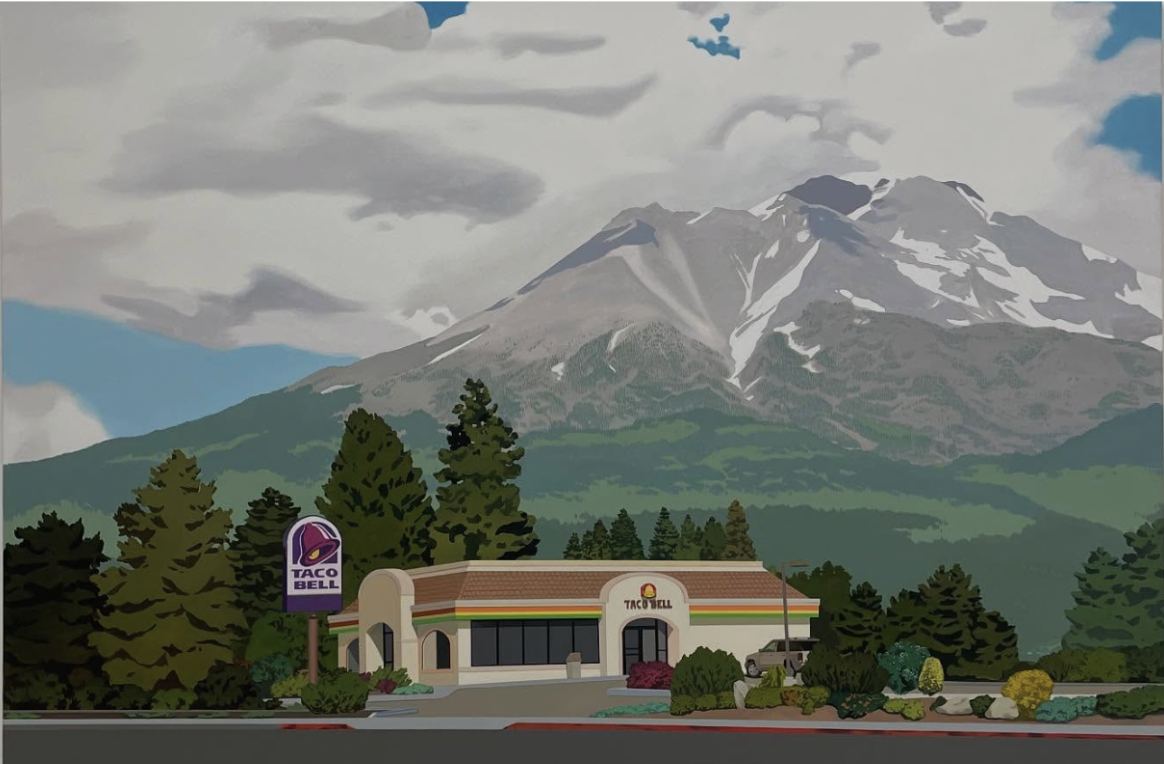
Weed, 2021, Oil on canvas
Jake Longstreth’s work and success as a painter indicate the lasting efficacy of sober realism. His scenes capture totems of modern suburban America: Best Buy, Chuck E. Cheese, Taco Bell, and an Amazon truck. Symbols of recognizable fast-food and retail chains that have become increasingly banal and obsolete to the contemporary viewer are immortalized in these scenes, often enveloped by trees and forest. However, these commercial chains are not the main subject of the paintings; they are small weeds… fleeting compared to the enduring landscapes. Often blending in or peaking out rather than dominating it. These paintings represent an artistic interest in the everlasting power of the natural world, unbothered by our disengagement.
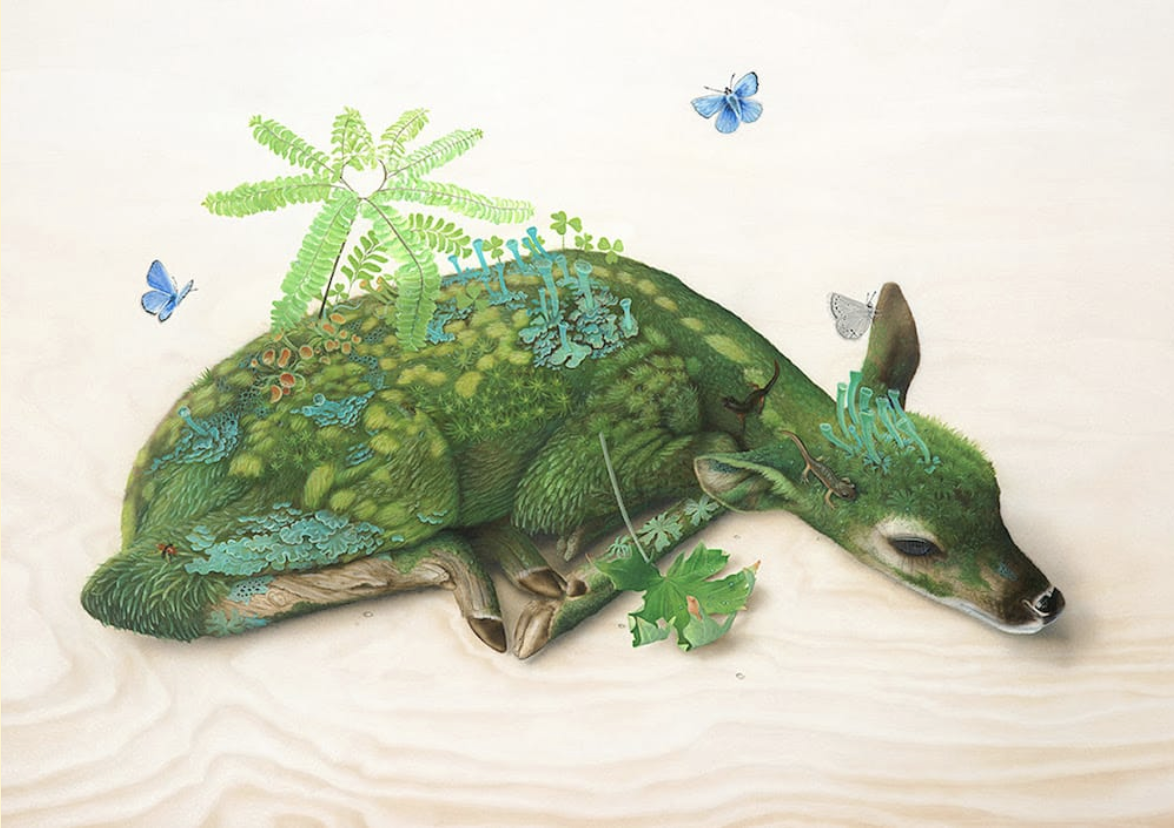
Flora and Fawn, 2016, Acrylic
Moving toward heightened detail and departing slightly from realism, Tiffany Bozic’s artwork focuses on hyperreal snapshots of nature and natural scenes. Her work maintains observational clarity while introducing compositional or contextual disruptions that shift the imagery away from straightforward naturalism. Her merger of technical precision with surreal organic imagery inspires the viewer to re-engage with the wonder that nature spurs in the human soul. Driven by an “ongoing search for universal commonalities between human beings and other living organisms,” her work offers an intimate and imaginative pathway for our re-engagement with nature. The human presence among the foliage is not directly depicted but inferred through her invention of “entirely new species (emerging) from the tip of her brush.”
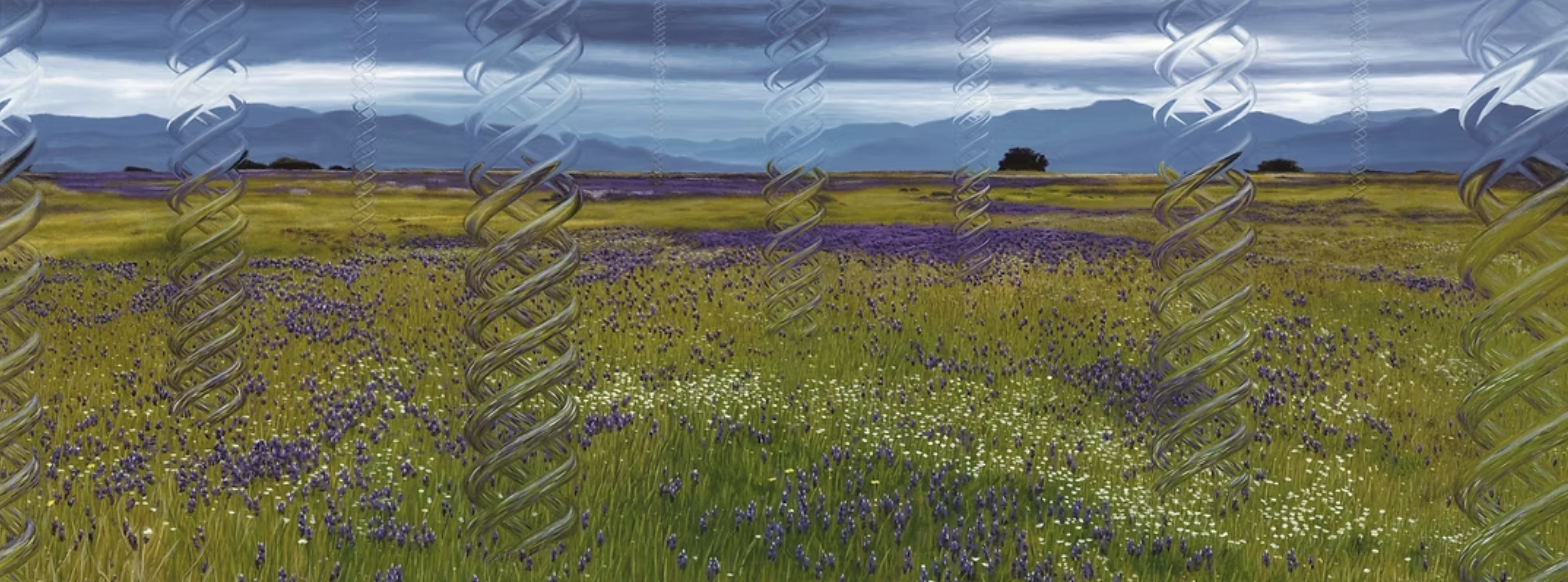
Supraterranean, 2022, Acrylic
Further along the spectrum, distortion becomes more explicit in Micah Ofstedahl's practice. He specializes in “altered realism,” a style that merges hyperrealistic landscapes with surreal glass-like distortions. These distortions are intended to be reminiscent of biological, cellular, and anatomical structures–the invisible structures of life made visible. Ofstedahl’s technical mastery invokes mystery when discovered online: is this the work of the brush or the pixel? At first glance, a viewer might mistake Ofstedahl’s landscapes for the rising movement of computer-generated sacred geometry, but further inquiry reveals a painter’s faithful commitment to handcrafted engagement with nature.
Across the spectrum of Neo-romanticism, the human relationship with nature manifests: a distinction can be drawn between the individual as an outside viewer vs. a fixture of the landscape. The works above lack human subjects, but the impression of human invention is legible. These artists remind us of our endowment with creativity as an innate trait, just as the fawn is endowed with spots at birth.
The works below feature human subjects embedding figures within dense environmental detail, surrounding them with ornamental or surreal botanical structures, or dissolving them into patterned space. These artists negotiate their own identity among the landscape, where the distinction between landscape and portraiture becomes blurred. The traits of the landscape become essential to characterizing the human subject.
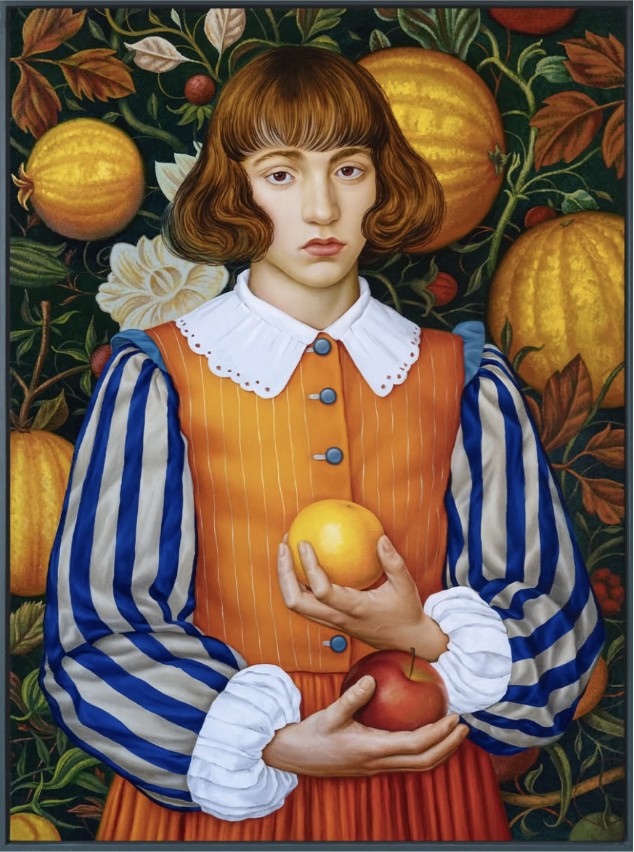
Portrait with an Apple and an Orange, 2025, Oil
Elen Bezhen situates the human figure within altered natural contexts. Her portraiture is largely based on historic realism, but operates in settings with a touch of fantasy. Many of the figures in her portraits are framed by a backdrop of botanical or floral patterns. Bezhen draws on classical painting techniques of Renaissance masters, and the traditional methods she employs in her paintings merge with contemporary visual language. This approach reflects a desire to identify with the organic world and tradition, however altered to interest the over-stimulated mind of the contemporary viewer.
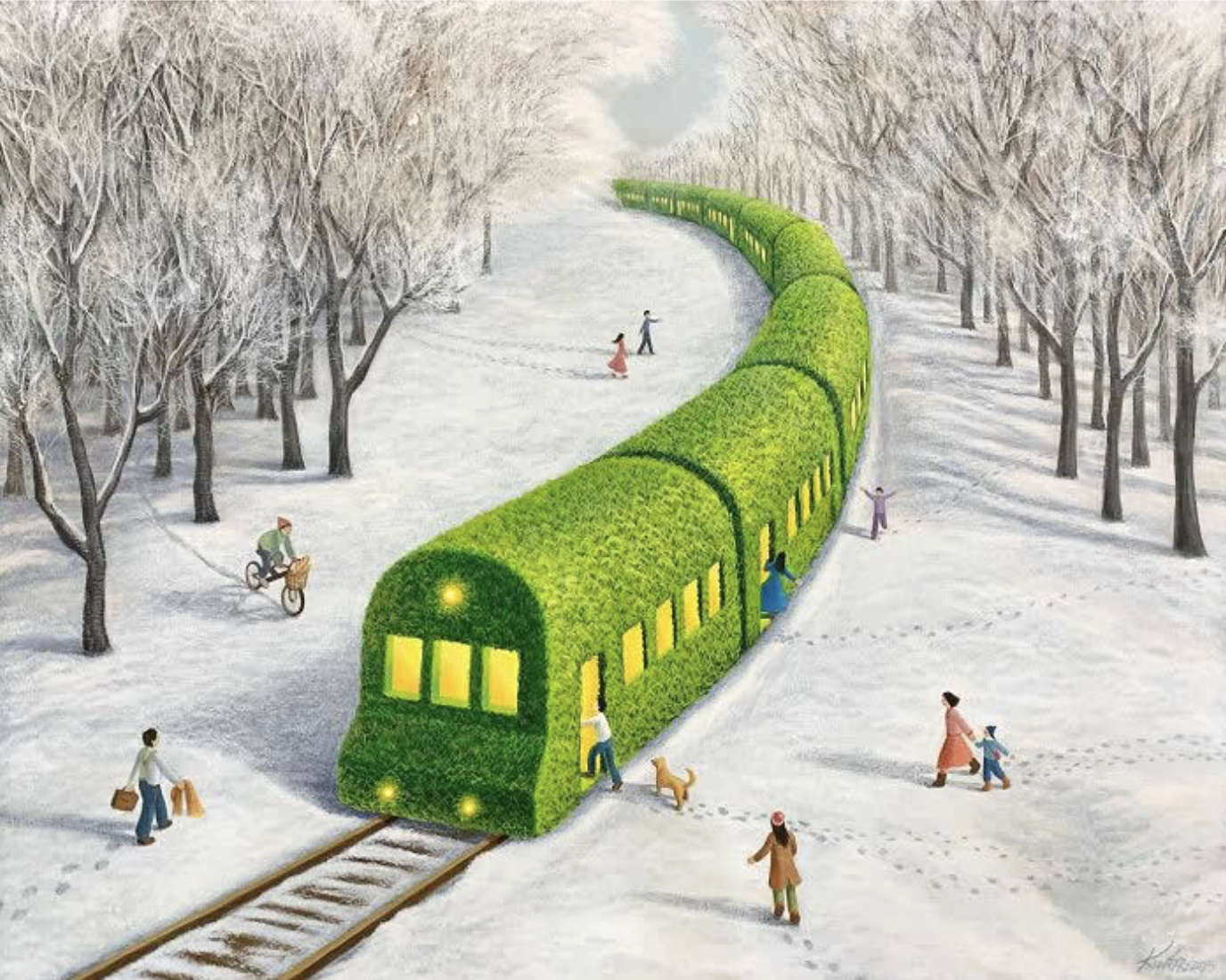
A Green Train, 2025, Acrylic and guache
Turning the volume up on surrealism, Mulgil Kim reimagines human inventions and the built world in harmony with nature. Her paintings render the natural world in bright colors, stylized forms, and an almost dream-like wonder. Nature is not observed in her artwork so much as idealized and reconstructed. The entire composition is a stand-in for a portrait of her mind: seeking intimacy with the changing seasons and the desire to share this intimacy with her viewers. Mulgil’s inventions provide an effective and fantastical trip out of our concrete matrix and into the wilderness of creation.
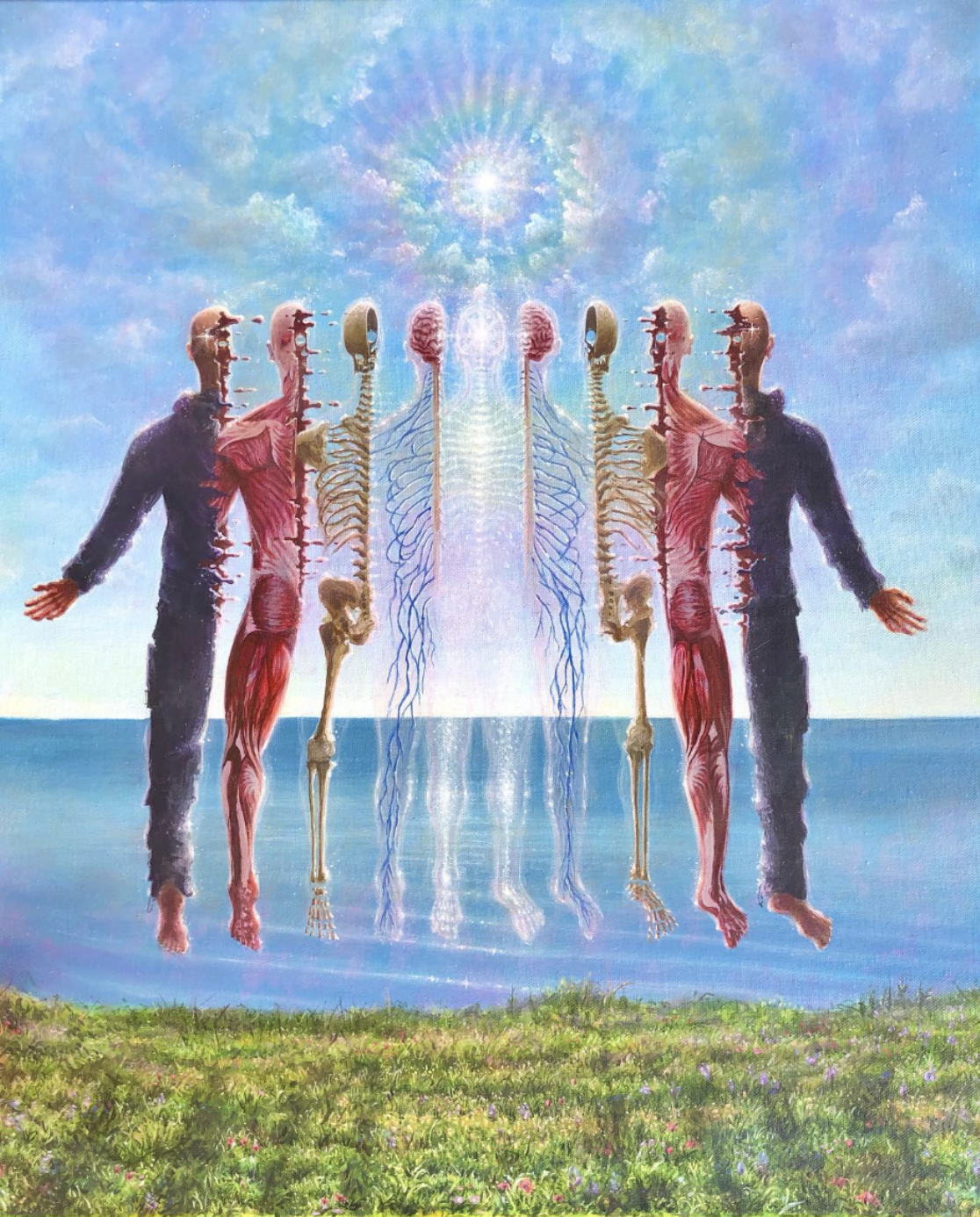
Fractal of Consciousness, 2023, Acrylic
Bradley Snook takes the human-nature connection to the next dimension. He synthesizes nature and the body through overtly psychedelic and conceptual portraits. His paintings explore themes of interconnectedness, human anatomy, and altered states of consciousness. Veins and nerves in human anatomy mirror natural phenomena like tree branches and lead structures. Often posted online alongside his deeply personal and existential reflections, his work is a testament to the criticality of nature in our contemporary search for identity.
The success these artists experience online is a testament to their effective capture of our attention in the digital age. But the question remains: to what extent do these pieces restore our connection with nature? Across the artists discussed, what emerges is not a return to unmediated nature, but a gradual transformation of nature into material that can be selectively recorded, visually distorted, composited with other symbolic elements, or entirely reconstructed as an imagined environment. The artists discussed here move beyond visual trends and instead push the boundaries of the conditions under which nature is seen, constructed, and experienced today. In doing so, they do not simply replicate the Romantic desire to return to nature, but reconfigure it–suggesting that in a post-digital world, our relationship to the natural world is no longer direct, but necessarily filtered, imagined, and reassembled through artistic intervention. Ultimately, Neo-Romanticism does not restore access to nature so much as it reveals how thoroughly that access has become simulated, and how contemporary painting participates in organizing that condition rather than remedying it.