Written By Emma Wright, April 9, 2026
When I first discovered Nina Sechko’s portraiture, I was immediately entranced by her dreamlike compositions, striking color choices, and the mysterious geometric girl reappearing across her work. On the surface, Nina Sechko’s work appears computer-generated.
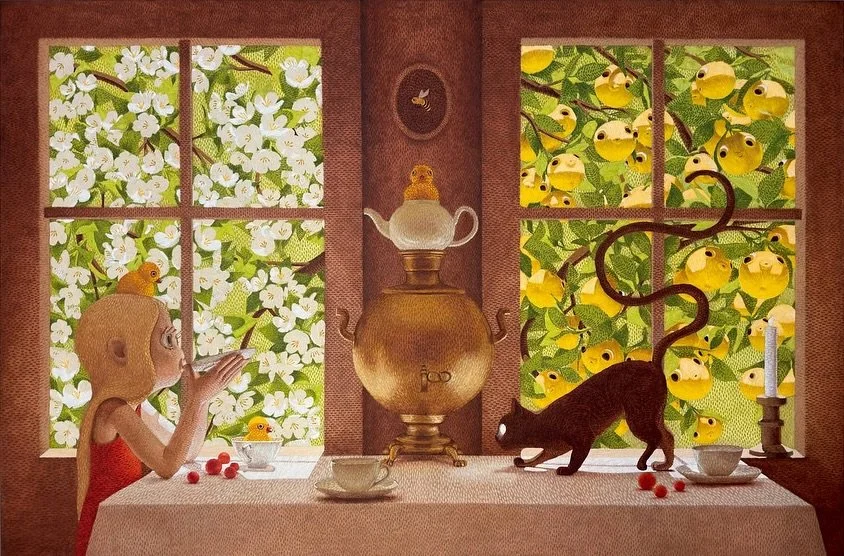
Taking a closer look, her compositions appear to be meticulously embroidered tapestries, but in fact, they are large-scale oil paintings executed to imitate Russian embroidery traditions. Intrigued to know more about her style, technique, and subject matter, I set out to interview the Russian artist and mother.
Throughout the interview, I began to realize the power of portraiture to go beyond representation of form, and a question continued occurring to me, “What happens when memory idealizes rather than preserves?”
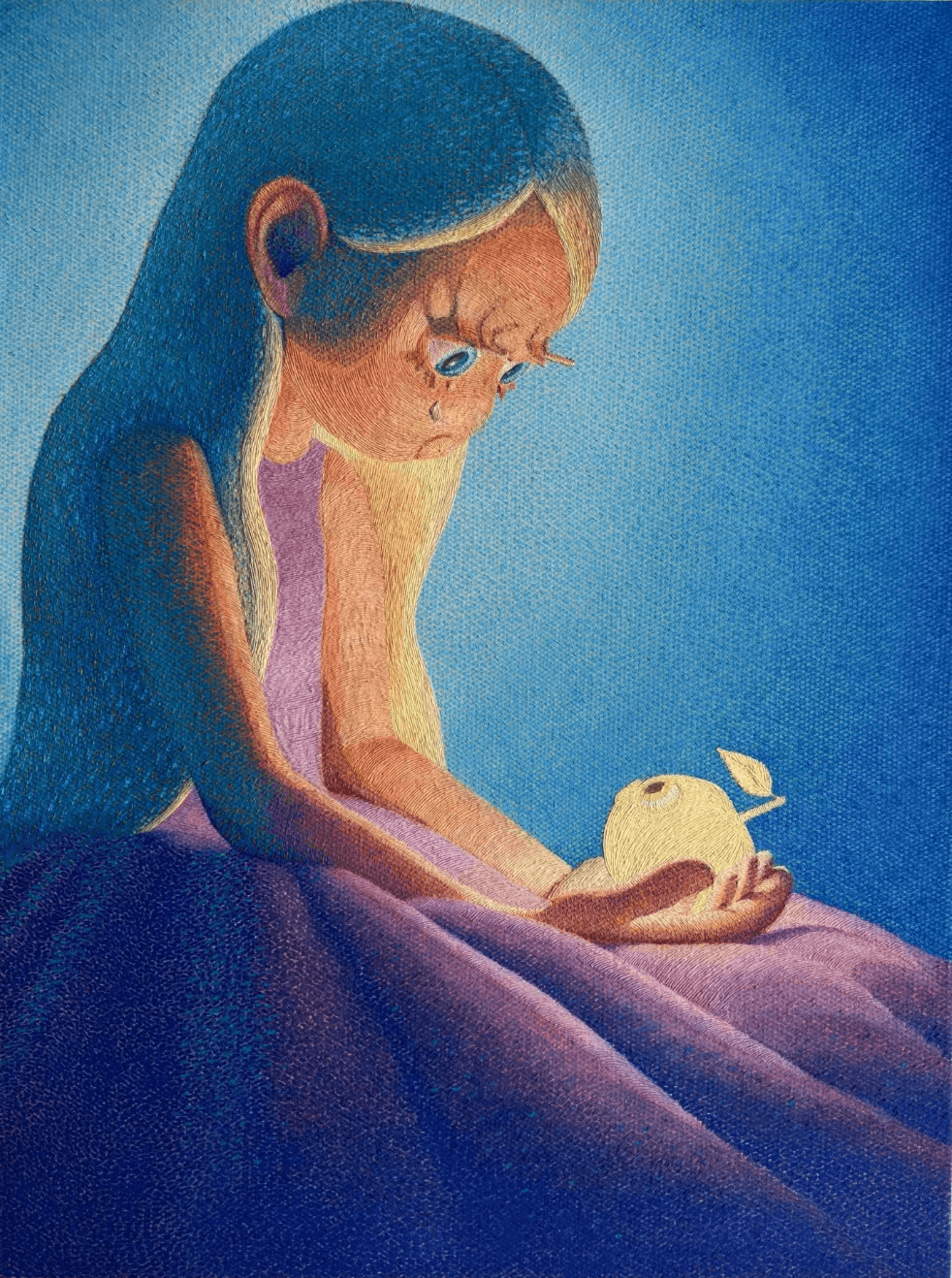
The Apple of Whispers, 2025
The following conversation reveals a deep human impulse: to reconstruct the past not as it was, but as we wished it to be by filtering out pain in favor of love and light. Sechko is an example to emerging artists of what is possible when we choose to remember the positive.
Emma Wright: You have consistently painted female figures and portraits, but there is a noticeable shift in your style around 2021. How would you describe the evolution of your artistic identity since your earlier work?
Nina Sechko:
Until 2022, I used to draw my friends, acquaintances, and self‑portraits. However, in 2022, certain events occurred that made me escape from reality — to retreat into an internal exile. I was afraid that this would affect me and I might lose my true self.
I tried to focus only on love and light, and I started drawing a great many sketches — to capture myself and my memories. At that time, what I was drawing was more important than how I was drawing it, so I didn’t even pay attention to faces or anatomy.
After some time, as I analysed my sketches, I realised that I was constantly drawing the same character. Their face was made up of simple geometric shapes, but the body still showed some sense of anatomy.
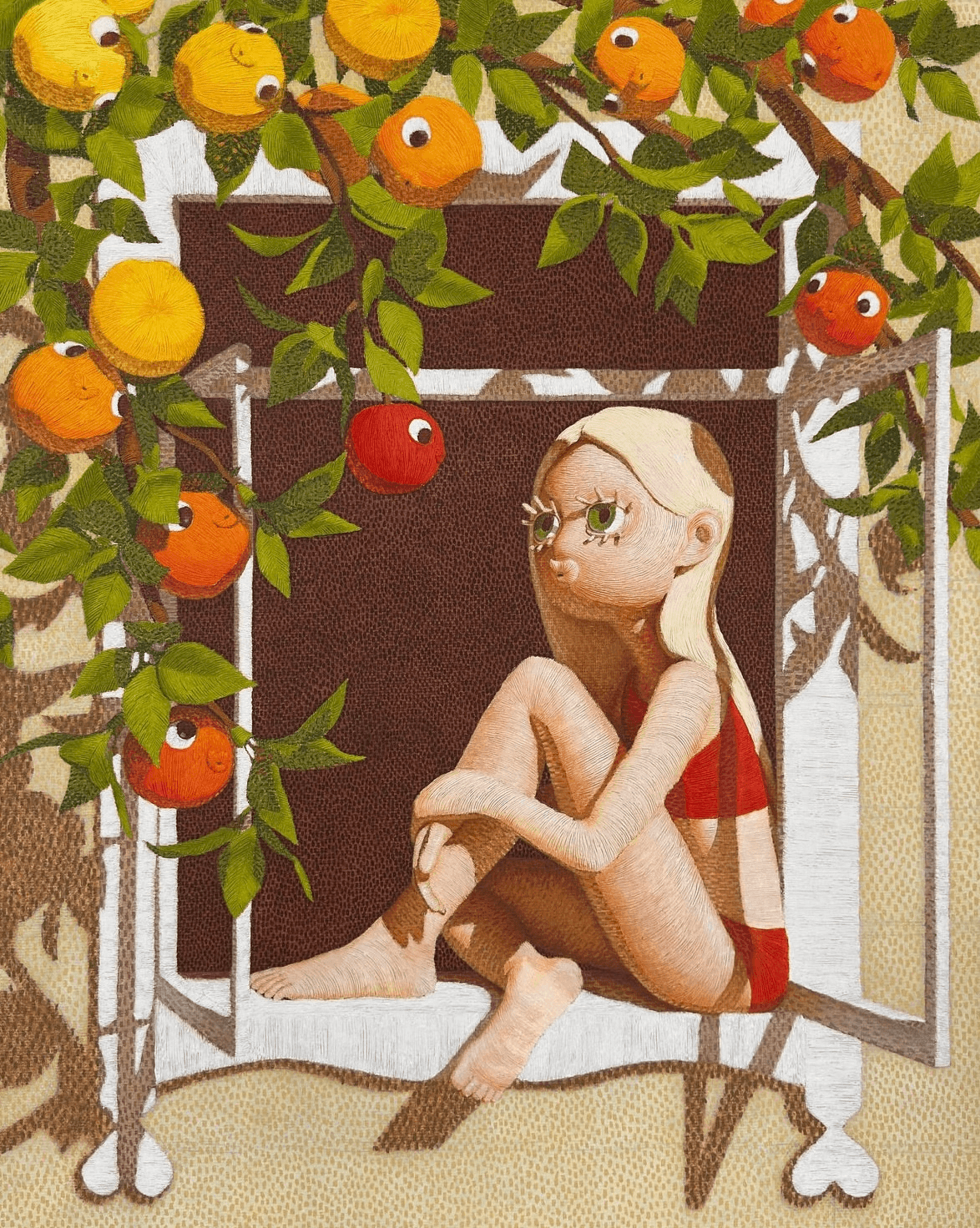
Sitting on the Window, 2025
Emma Wright: Is there a specific moment, piece, or technique that you think marked a turning point in your career as an artist?
Nina Sechko:
There isn’t one particular work that stands out, but the first things that come to mind are Rembrandt’s technique with its translucent shadows and emphasis on light, and the bright, vivid colours of Boris Kustodiev.
In general, I’ve been passionate about visual art all my life, and I collect visual references of things I like. My phone’s photo roll is filled with screenshots and photos. Sometimes these are crops of colour combinations, patterns, textures, or close‑ups of details that remind me of something.
Overall, I capture everything in my life through a visual language. If something isn’t sketched or photographed, it doesn’t register in my memory — it’s as if it never happened.
Emma Wright: Your works have a dreamy quality that makes me wonder what inspires your compositions. Are you depicting specific moments from your life, or drawing more from your imagination?
Nina Sechko:
Most often, I write down memories from the past, but this is more of a simulation of the past, since time distorts these memories. That’s why everything looks like a 3D render — like an ideal memory.
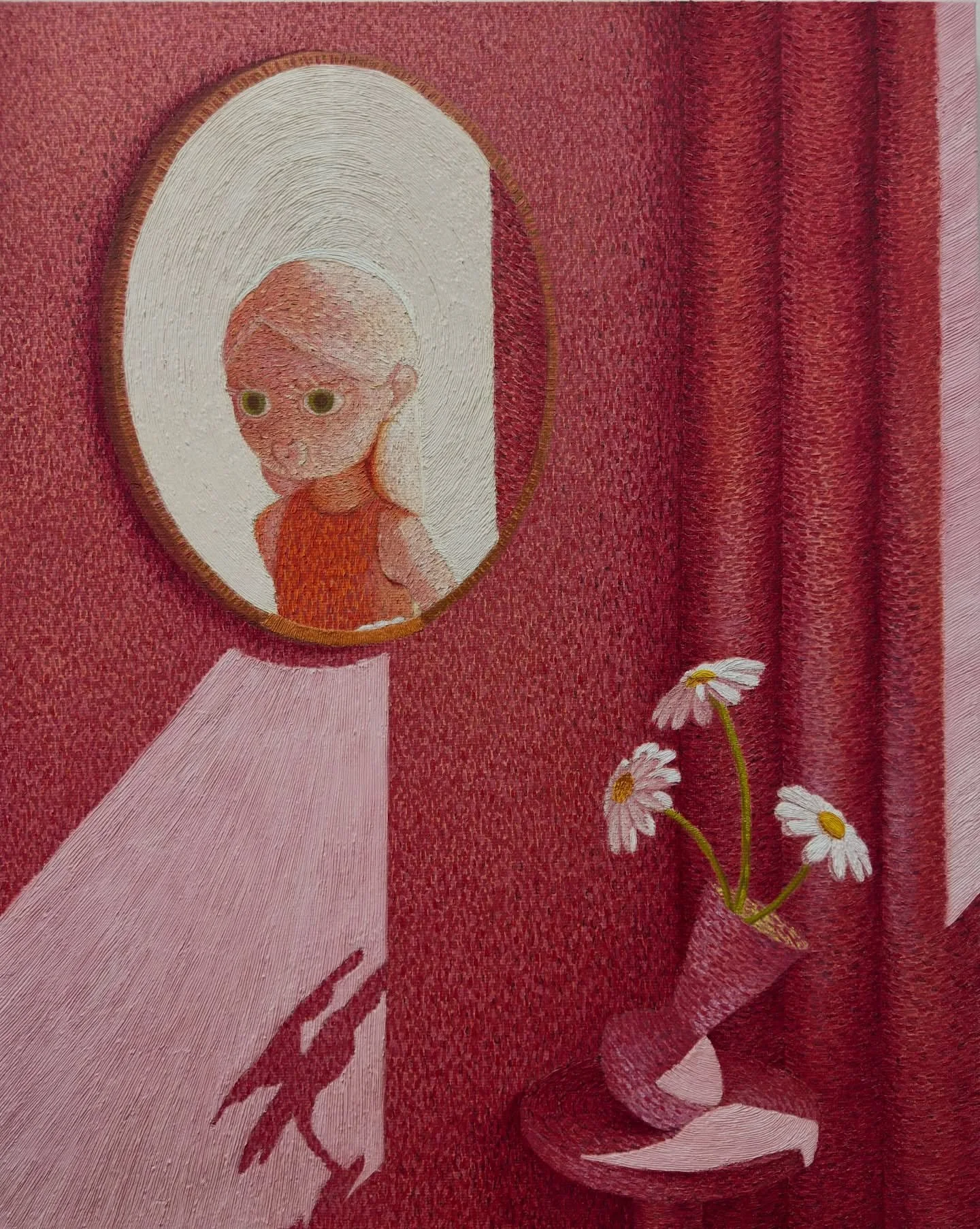
The Fragility of a Moment, 2026
Emma Wright: You have developed a unique and recognizable style, especially texturally. What inspired this painting style, and what advice might you have for young artists hoping to achieve a similar singularity?
Nina Sechko:
Imitating embroidery is a very important gesture in my artistic practice.
Embroidery with flat stitches (embroidery in the glad’ technique) is a well‑known Russian craft traditionally practiced by women. My family includes many women, and from childhood we were encouraged to spend our free time embroidering or knitting — to spend hours in a monotonous, almost meditative state. This is long and arduous manual labour, which I imitate in my work.
That said, I don’t work with embroidery itself, but with its image — as if with the memory of a tradition, rather than the tradition itself.
My advice is to experiment without looking to anyone for approval. It’s not difficult to learn how to paint; the challenge lies in learning to use only those visual languages and subjects that help reveal and strengthen the idea. The inclusion of every texture and every additional element must be justified.
Emma Wright: The vibrant and distinct color palettes in your latest work are quite striking. What’s your process for choosing your color palette for specific paintings?
Nina Sechko:
I have a limited colour palette, usually five colours. All my works use the same palette, the same paints that I mix. First and foremost, I focus on the emotion I want to convey through the painting.
Tea Time, 2025
Emma Wright: Do you think you will continue expanding your body of work with this particular style, or do you see a new horizon in your future?
Nina Sechko:
This is the visual language of my art, and for now, I’m comfortable speaking it. In the future, I plan to go beyond the canvas: to work with sculpture and also to make the narrative elements more complex.
Emma Wright: From your experience exhibiting with Robineau Art–connecting with curators, visitors, and collectors–has a viewer’s interpretation of your work ever changed how you view it?
Nina Sechko:
Most of the time, people pick up everything I put into my work. Of course, they often project their own experience and memories onto it, thereby creating a new experience connected to my art.
Sechko’s work challenges a simple yet glaring assumption that art is about representing the world as it is. She reminds us that art, like memory, is about survival. It is about reshaping what we have experienced into something we can grasp, understand, and even something that, though often distorted, feels true.
If every memory we possess is already a kind of fiction, then maybe the question is not whether her paintings are real, but whether they are any less real than the stories we tell ourselves to keep going.